15 Science-Backed Strength Training Tips to Get Stronger Every Day
Author: RVLNSV PRASAD
Updated On: October 2026
About Us
Author Bio
Editorial Policy
Contact Us

Introduction
Getting stronger does not require the most complicated workout program, the heaviest weights in the gym, or a perfect fitness routine.
For most people, strength is built through a combination of consistent resistance training, gradual progression, adequate recovery, nutritious food, sleep, and realistic expectations.
That matters because many people begin exercising with enthusiasm but struggle to maintain the routine once work, family responsibilities, travel, fatigue, or ordinary life gets in the way.
The better approach is to build a training system that can survive real life.
The evidence for resistance training is also stronger than the old idea that strength exercise is only for athletes or bodybuilders. A 2026 American College of Sports Medicine position stand, based on 137 systematic reviews involving more than 30,000 participants, found that resistance training improves muscle strength, muscle size, power, endurance, balance, gait speed, and several measures of physical function in healthy adults. ACSM Position Stand: Resistance Training Prescription for Muscle Function, Hypertrophy and Physical Performance
That gives us a useful starting point.
You do not need to become an elite athlete; what matters is having a sensible approach to training, recovery, gradual progress, and long-term consistency.
Quick Answer: How Can You Get Stronger Every Day?
The most reliable way to become stronger is to perform resistance training consistently, use good technique, gradually increase training demands, train the major muscle groups, eat enough nutritious food, get adequate recovery, and adjust the program to your current ability.
Adults should generally include muscle-strengthening activity on at least two days each week, alongside recommended aerobic activity. The CDC currently recommends at least 150 minutes of moderate-intensity aerobic activity per week for adults, plus muscle-strengthening activity on two or more days. CDC: Adult Physical Activity Guidelines
You do not need to begin at the full recommendation if you are currently inactive.
Starting with a manageable amount and gradually building your routine can be more realistic and sustainable.
Key Takeaways
- Resistance training is useful for strength, muscle, physical function, and healthy aging.
- Beginners should prioritize technique before heavy loading.
- Progressive overload is important, but progression does not mean adding weight every workout.
- Consistency matters more than an occasional extremely hard session.
- Full-body and split routines can both work when the overall training program is appropriate.
- Protein and overall nutrition support adaptation to resistance training.
- Sleep and recovery are part of training, not wasted time.
- Aerobic activity and strength training complement each other.
- Tracking performance can reveal progress that the mirror does not show.
- A difficult-day version of your workout can make consistency easier.
- Pain that is severe, persistent, or unusual should not simply be pushed through.
- The best strength program is one you can perform safely and consistently.
What Actually Makes You Stronger?
Strength does not appear because you exercised once.
Your body adapts to repeated training demands.
Resistance exercise provides a stimulus. Your body responds to that stimulus through neurological and muscular adaptations. Over time, appropriately programmed training can improve your ability to produce force and perform physical tasks.
The latest ACSM evidence synthesis found meaningful benefits from resistance training across strength, hypertrophy, power, endurance, gait speed, balance, and physical function. PubMed: 2026 ACSM Overview of Reviews
That is why the goal should not simply be
“Work out harder.”
A better goal is
“Give my body a useful training stimulus and enough recovery to adapt.”
This distinction can prevent a common mistake: assuming that soreness and exhaustion are proof of an effective workout.
They are not.
1. Start With a Training Dose You Can Actually Maintain
One of the biggest mistakes beginners make is starting with an unrealistic program.
A person who has not exercised for months may suddenly decide to train six days a week.
The first week may feel exciting, but by the second week, staying consistent can become more challenging.
By the third week, the routine disappears.
A better strategy is to begin with a training amount that fits your current life.
For some beginners, starting with two full-body resistance sessions each week may work well, while others may benefit from shorter sessions as they gradually build the habit.
The CDC emphasizes that some physical activity is better than none and that adults can build activity into their lives in different ways. CDC: Adding Physical Activity as an Adult
People-First Insight
Do not build your first workout plan around your motivation. Build it around your schedule.
Motivation changes.
A realistic schedule is more dependable.
2. Learn the Movement Before Chasing Weight
Adding more weight is not the first definition of progress.
If your technique is unstable, increasing the load can make the exercise harder to control.
Start by learning the movement.
For example, a beginner might first practice:
- Squatting to a comfortable depth
- Hip-hinge mechanics
- Push-up variations
- Rowing movements
- Overhead pressing when appropriate
- Carrying movements
- Core bracing
The exact exercises can vary according to ability, equipment, age, goals, and medical considerations.
The objective is to make the movement controlled and repeatable.
A Simple Rule
Control first. Load second.
This does not mean every repetition has to be slow.
It means you should understand what you are doing before continually adding resistance.
3. Use Progressive Overload Without Rushing
Progressive overload is one of the central concepts in strength training.
It means gradually exposing your body to an appropriate increase in training demand.
That increase can come from:
- More weight
- More repetitions
- Additional sets
- Greater exercise difficulty
- Better range of motion
- Improved technique
- More challenging variations
- Better control
Progression does not mean increasing weight every session.
Sometimes the best progress is performing the same load with better technique.
The current ACSM evidence review emphasizes that resistance-training prescriptions can be adapted across different goals and training approaches rather than relying on one universal program. ACSM Position Stand
4. Train the Major Muscle Groups
- A strong program should not focus only on the muscles that are easiest to see in a mirror.
- A balanced routine should include movements that train major muscle groups.
- A simple framework can include:
| Movement pattern | Example |
|---|---|
| Squat | Squat or chair squat |
| Hinge | Hip hinge or deadlift variation |
| Push | Push-up or press |
| Pull | Row or pulldown |
| Carry | Farmers carry |
| Core | Plank or controlled trunk exercise |
The exact exercises should match your experience and physical ability.
5. Choose Full-Body or Split Training Based on Your Life
People sometimes argue about whether full-body workouts or split routines are superior.
The more useful question is
Which structure allows you to train consistently and cover the muscle groups you want to develop?
A 2024 systematic review and meta-analysis comparing split and full-body resistance training found no clear overall superiority of one approach when training variables were appropriately considered. PubMed: Split Versus Full-Body Resistance Training
That is good news for ordinary people.
- If you can train two or three times per week, a full-body routine may be convenient.
- If you train more frequently, a split program may fit your schedule.
- The program should serve the person.
The person should not have to reorganize their entire life around the program.
6. Do Not Confuse Soreness With Progress
Muscle soreness can happen after unfamiliar or demanding exercise.
But soreness is not the same thing as strength improvement.
A workout can be productive without leaving you unable to walk normally the next morning.
Likewise, an extremely sore session does not automatically mean you trained better.
Track performance instead.
Ask:
- Did I perform more repetitions?
- Did my technique improve?
- Did I use a heavier load safely?
- Did I complete the planned sets?
- Did the movement feel more controlled?
- Can I perform the activity with less fatigue?
These measures are more useful than chasing soreness.
7. Keep a Simple Training Log
You do not need an expensive fitness application.
A notebook can be enough.
Record:
Exercise → sets → repetitions → resistance → notes
For example:
| Exercise | Sets | Reps | Load | Note |
|---|---|---|---|---|
| Squat | 3 | 8 | Comfortable | Good form |
| Row | 3 | 10 | Moderate | Last reps challenging |
| Push-up | 3 | 8 | Bodyweight | Controlled |
| Carry | 3 | 30 sec | Moderate | Grip improving |
After several weeks, the log can reveal progress that is difficult to notice from day to day.
This is particularly helpful for people who become discouraged because physical changes are gradual.
8. Combine Strength Training With Aerobic Activity
Strength training should not replace aerobic activity.
The two forms of exercise provide different but complementary benefits.
Current U.S. guidance recommends at least 150 minutes of moderate-intensity aerobic activity each week, or 75 minutes of vigorous activity, along with muscle-strengthening activity on at least two days. CDC: Physical Activity Guidelines
Walking is an accessible way to build aerobic activity.
Cycling, swimming, jogging, dancing, recreational sports, and other activities can also count depending on intensity and individual ability.
A Practical Combination
You might use:
Strength training: 2–3 days
Walking or other aerobic activity: several days
Mobility/recovery: short sessions as useful
This does not mean every day needs to be a workout.
Daily movement and structured training are different things.
9. Eat Enough Protein and Nutritious Food
Training creates a demand for recovery.
Food provides energy and nutrients needed to support that process.
Protein is particularly relevant because resistance training stimulates muscle protein synthesis.
A large systematic review and meta-analysis found that protein supplementation can provide additional gains in muscle size and strength during prolonged resistance training, although supplementation is not automatically necessary for everyone. PubMed: Protein Supplementation and Resistance Training
This distinction is important.
Protein powder is a convenience, not a requirement.
Protein can come from foods such as:
- Eggs
- Fish
- Poultry
- Yogurt
- Milk
- Soy foods
- Beans
- Lentils
- Peas
- Nuts and seeds
The overall diet also matters.
A person cannot build a strong foundation from protein alone while consistently neglecting fruits, vegetables, whole grains, healthy fats, and other nutrient-dense foods.
10. Treat Sleep as Part of Training
A workout provides a stimulus.
Recovery gives your body the opportunity to adapt.
Sleep is therefore not something to squeeze in after everything else.
It belongs inside the training plan.
Research has found that inadequate sleep can negatively affect some aspects of resistance exercise performance. A 2025 systematic review also found evidence that sleep deprivation can reduce some measures of strength, power, and muscular endurance, although results differed between studies. PubMed: Sleep Loss and Muscle Strength
Earlier systematic evidence also suggests that chronic resistance exercise may improve aspects of sleep quality. PubMed: Resistance Exercise and Sleep
This creates a useful two-way relationship:
Training can support sleep.
Sleep can support training.
Do not treat them as competing priorities.
11. Build a Recovery Strategy Before You Need One
Recovery does not need to mean lying on the sofa all weekend.
It means managing training stress so that you can continue performing effectively.
Useful recovery habits can include:
- Adequate sleep
- Regular meals
- Hydration
- Rest days or easier sessions
- Managing training volume
- Gentle movement
- Appropriate warm-up
- Adjusting exercise when unusually fatigued
A useful concept is active recovery.
On a difficult day, instead of forcing another hard workout, you might take a walk or perform gentle mobility work.
That keeps the habit alive without unnecessarily increasing training stress.
12. Create a Difficult-Day Workout
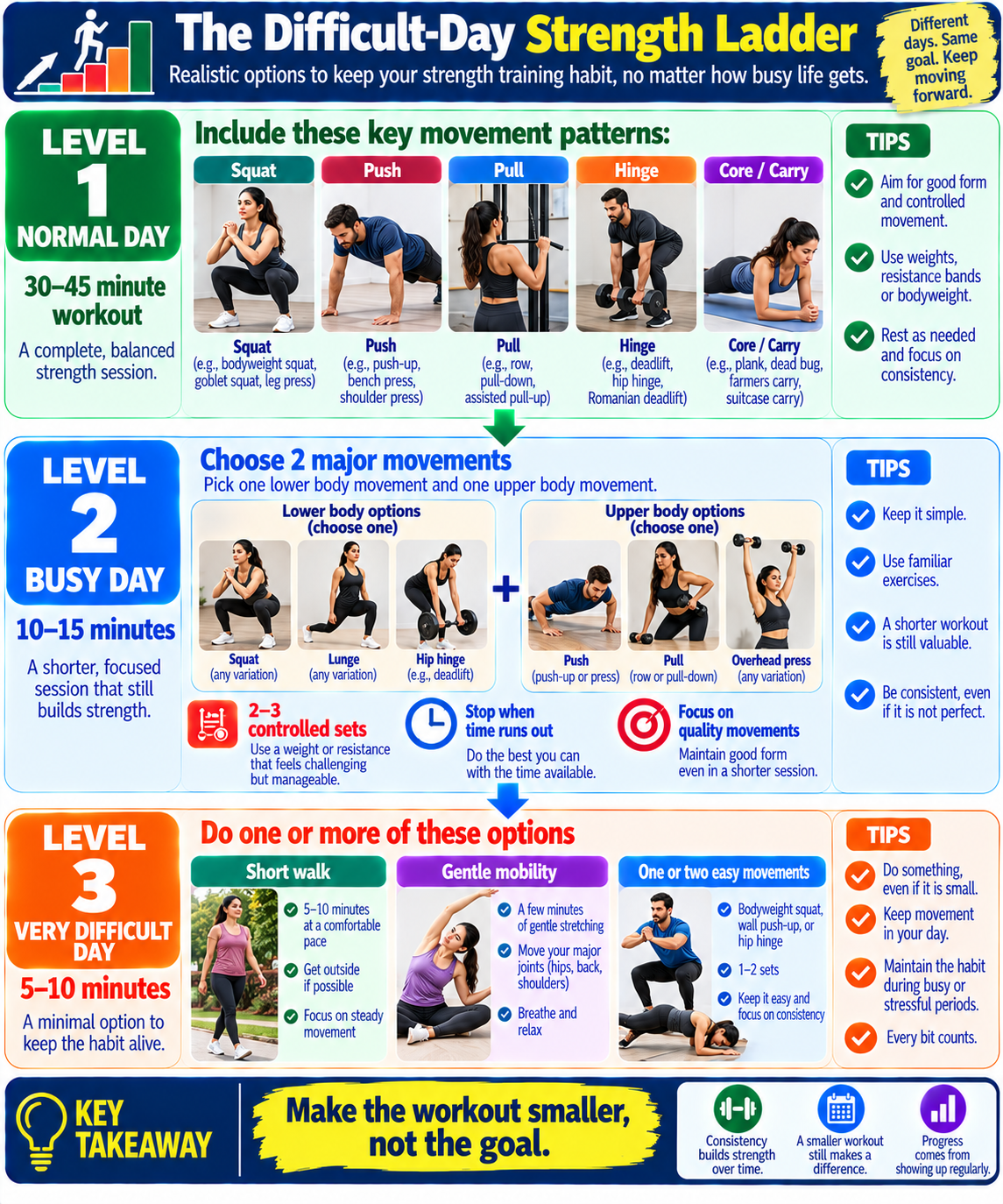
This is one of the most useful strategies for long-term consistency.
Most people have two kinds of days:
Normal days
and
Life happens day by day.
Your training plan should have both versions.
Normal Day
30–45 minute structured session.
Difficult Day
10–15 minutes of selected movements.
Very Difficult Day
A short walk and mobility work.
The objective is not to pretend that a 10-minute session is identical to a full resistance workout.
It isn’t.
The purpose is to prevent an imperfect day from becoming an abandoned routine.
The CDC notes that any amount of physical activity has some health benefit and encourages people to choose activities that fit their abilities and circumstances. CDC: Adding Physical Activity as an Adult
13. Do Not Ignore Mobility and Movement Quality
Strength is useful.
But strength through a movement you cannot control is not the same as useful physical capacity.
Include movements that allow you to work through comfortable ranges of motion.
For some people, this could mean:
- Controlled squats
- Hip mobility
- Shoulder movement
- Ankle mobility
- Thoracic movement
- Gentle stretching
Mobility work should complement your training rather than become another complicated program.
If a particular movement causes pain, especially sharp or persistent pain, do not simply assume that more stretching or more repetitions will solve it.
14. Measure Performance Instead of Only Appearance
The mirror can be an unreliable progress report.
Strength can improve before visible muscle changes become obvious.
Instead, track functional improvements.
You might notice:
- Carrying groceries becomes easier.
- Climbing stairs becomes less tiring.
- You can perform more push-ups.
- You can lift a familiar object more comfortably.
- Your balance improves.
- Your posture feels more controlled.
- Your walking pace improves.
- You can perform a movement with better technique.
These changes matter.
The 2026 ACSM review found benefits from resistance training across not only muscle strength and size but also physical function, balance, gait speed, power, and endurance. PubMed: ACSM Resistance Training Position Stand
That means the value of getting stronger extends beyond appearance.
15. Give the Process Enough Time
Perhaps the hardest strength-training habit is patience.
They often compare their first month with someone else’s fifth year.
That comparison is unfair.
Strength development depends on factors such as
- Training history
- Age
- Genetics
- Exercise selection
- Training volume
- Nutrition
- Sleep
- Recovery
- Health status
- Consistency
Your progress does not have to look like somebody else’s.
Instead of asking:
“Why don’t I look different yet?”
ask:
“What can I do now that I couldn’t do before?”
That question creates a much healthier definition of progress.
Strength Training at Home: You Need Less Equipment Than You Think
A gym can be useful, but it is not mandatory.
Depending on your fitness level, home training can include:
- Squats
- Chair squats
- Wall push-ups
- Incline push-ups
- Resistance-band rows
- Resistance-band presses
- Step-ups
- Lunges
- Carries
- Core exercises
As your ability improves, you may eventually need additional resistance or more challenging variations to continue progressing.
The equipment should follow your training needs.
You do not need to purchase a room full of equipment before starting.
The “Two-Exercise Rule” for Busy Days
Here is a simple strategy for people who repeatedly skip workouts because they do not have enough time.
Choose two major movements.
For example:
Squat + push
or
Hinge + pull
Perform a few controlled sets.
If you have more time, you can continue; otherwise, stopping after the planned portion is perfectly fine.
This removes the all-or-nothing mentality.
A short session may not provide the same training stimulus as a complete workout, but it can make the next session easier to return to.
Nutrition: Build Meals Around Recovery, Not Supplements
The fitness industry often makes nutrition seem complicated.
It does not have to be.
A practical meal can contain:
Protein + vegetables or fruit + carbohydrate + healthy fat
The proportions can vary depending on energy needs, goals, culture, medical conditions, and individual preferences.
For example:
| Meal | Practical combination |
|---|---|
| Breakfast | Eggs + oats + fruit |
| Lunch | Beans or chicken + vegetables + rice |
| Snack | Yogurt + fruit |
| Dinner | Fish/tofu/lentils + vegetables + potatoes or whole grains |
| Quick option | Greek yogurt or another protein food + fruit + whole-grain food |
People with kidney disease or other medical conditions may need individualized dietary advice, particularly regarding protein or other nutrients.
A Simple Weekly Strength Framework
A beginner-friendly structure might look like this:
| Day | Activity |
|---|---|
| Monday | Full-body strength |
| Tuesday | Walking or other aerobic activity |
| Wednesday | Recovery or easy movement |
| Thursday | Full-body strength |
| Friday | Walking |
| Saturday | Optional strength or recreational activity |
| Sunday | Recovery |
This is an example, not a universal prescription.
Your schedule should depend on your fitness level, goals, recovery capacity, health status, and available time.
The CDC also provides example weekly schedules that combine aerobic and muscle-strengthening activity. CDC: Adult Activity Examples
Latest Research Developments: What Is Changing in Strength Training?
Strength-training advice has changed considerably from the old idea that there is one perfect workout prescription.
The 2026 ACSM Evidence Review Is Important
The new ACSM position stand synthesized 137 systematic reviews involving more than 30,000 participants.
The findings support resistance training for improvements in muscle strength, hypertrophy, power, endurance, gait speed, balance, and physical function. ACSM 2026 Position Stand
For readers, the practical message is significant:
Resistance training is not only about building bigger muscles.
It can help build physical capacity.
Full-Body Versus Split Training Is Less Important Than Many People Think
The 2024 systematic review comparing full-body and split routines did not find a clear overall winner when training variables were considered. PubMed: Full-Body vs Split Training
This supports a more flexible approach.
Choose the structure that fits your schedule and allows you to train consistently.
Sleep Is Receiving More Attention
The research base also continues to explore how sleep loss affects physical performance.
A 2025 systematic review found that sleep deprivation was associated with reductions in some measures of strength, power, and muscular endurance, while acknowledging differences between studies. PubMed: 2025 Sleep and Strength Review
This strengthens the case for treating recovery as part of fitness rather than an optional extra.
Protein Research Is Becoming More Nuanced
Protein clearly matters for muscle adaptation, but that does not mean everyone needs a large amount of protein powder.
Evidence suggests protein supplementation can modestly increase gains during resistance training, but total diet, training quality, and individual needs still matter. PubMed: Protein Supplementation Meta-Analysis
That is a better message than simply telling every reader to buy supplements.
Common Strength Training Mistakes
Doing Too Much Too Soon
A beginner who suddenly doubles training volume can create unnecessary fatigue.
Build gradually.
Changing Programs Every Week
Your body needs time to adapt.
Constantly changing exercises makes progress harder to evaluate.
Chasing Heavy Weights
Heavy loading has a place in strength training, but it should be appropriate to the person’s experience and goals.
Ignoring Technique
A heavier weight with poor control is not automatically better.
Training Through Significant Pain
Normal effort and muscle fatigue are different from sharp, severe, or persistent pain.
Neglecting Recovery
More training is not always better.
Comparing Yourself With Advanced Lifters
Someone else’s five-year progress is not a fair comparison for your first six months.
Believing Supplements Are the Main Solution
Supplements cannot replace a well-designed training program, adequate food, sleep, and consistency.
A People-First Strength Strategy: Make Your Plan Smaller, Not Bigger
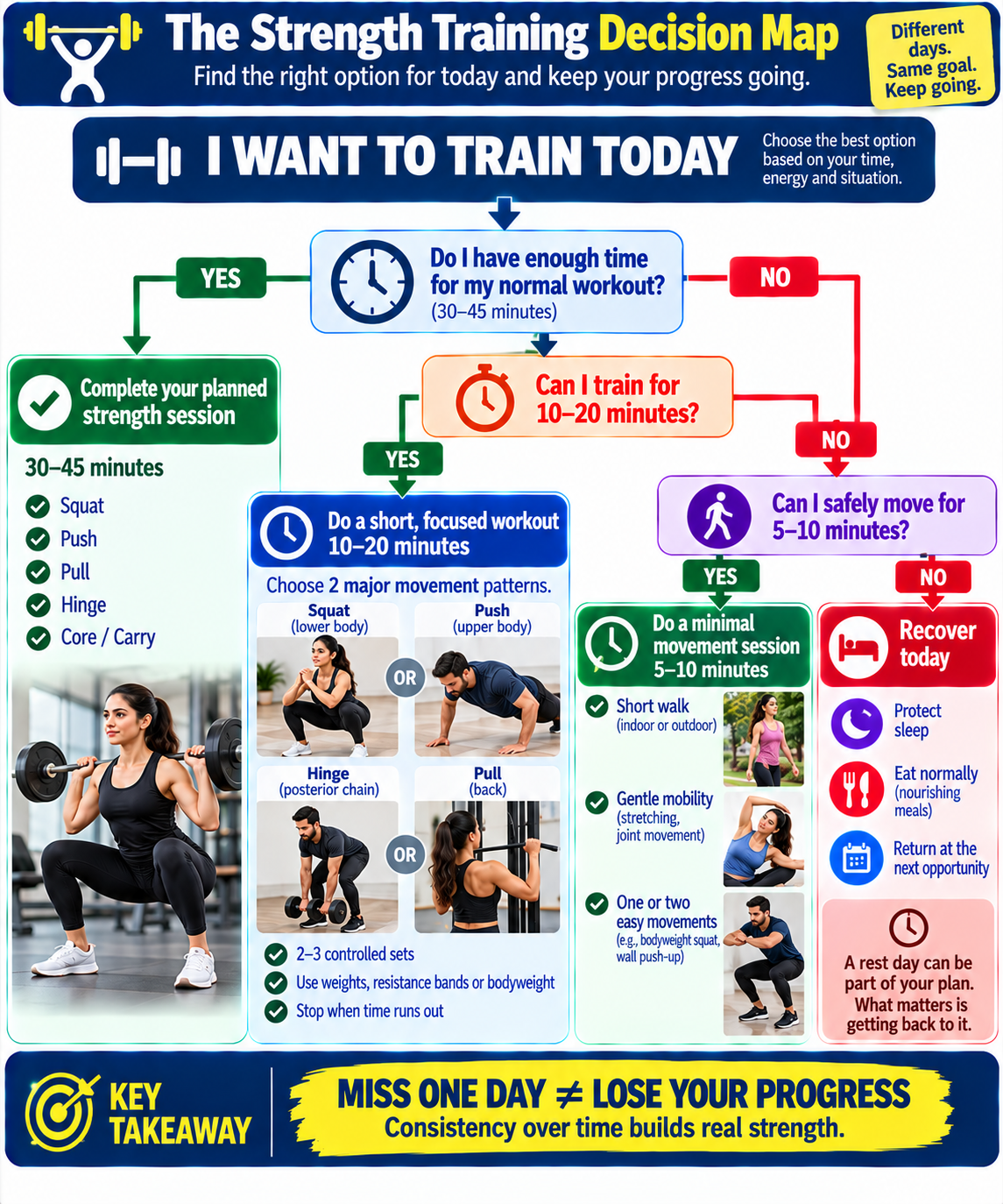
When people struggle with consistency, they often respond by searching for a better program.
Sometimes the program is not the problem.
The plan may simply be too large for their life.
Instead of adding more:
Reduce the friction.
- If you cannot train for 45 minutes, train for 20.
- If you cannot reach the gym, train at home.
- If you cannot complete the full program, perform the key movements.
- If you miss Monday, do not wait until next Monday.
Return at the next available opportunity.
That is how stronger every day becomes a realistic concept rather than a motivational slogan.
My Personal Experience With Building Consistency
I have experienced periods when exercise looked easy on paper but was difficult to maintain in real life.
The problem was not always a lack of knowledge.
Sometimes the plan simply demanded too much.
I found that simpler routines were easier to repeat.
Instead of constantly changing workouts, I focused on basic movements and gradual improvement. Walking also became useful because it did not require a complicated setup.
Over time, I learned that progress feels more obvious when you track small improvements rather than waiting for a dramatic physical transformation.
That experience changed how I think about fitness.
A routine does not have to impress anyone.
It needs to work for the person doing it.
How to Know When Your Program Is Working
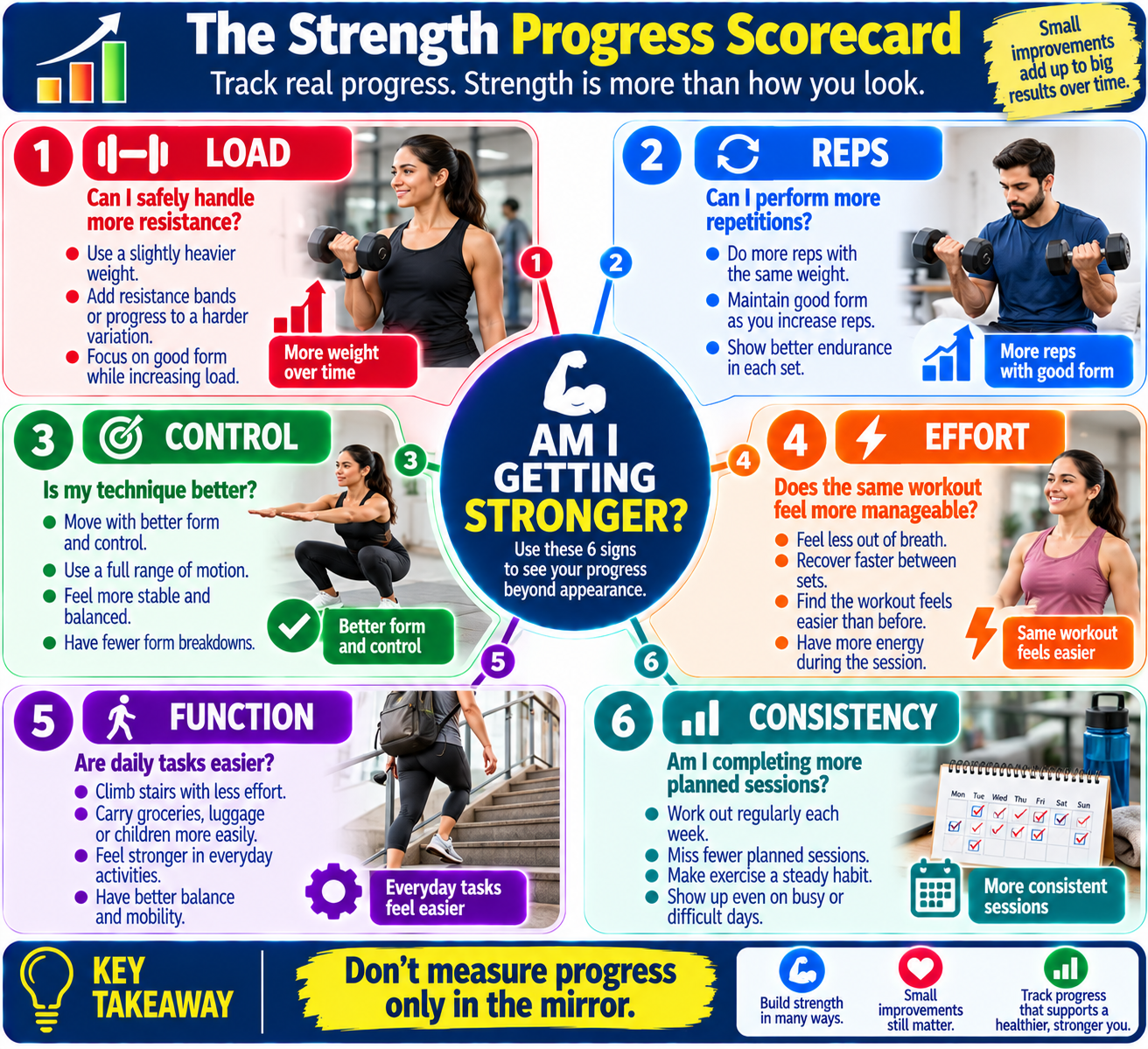
Look for several signs.
As you progress, you may increase your repetitions while gradually developing more controlled and confident technique.
The same weight may feel easier.
You may tolerate activity better.
Daily tasks may feel less demanding.
As you become more consistent, your confidence may improve, and your recovery may become more predictable.
These are meaningful outcomes.
Do not judge your program solely by body weight or appearance.
When to Modify or Stop an Exercise
Exercise should challenge you, but it should not require ignoring warning signs.
Stop an exercise and seek appropriate medical or professional advice when you experience symptoms such as:
- Chest pain
- Fainting
- Severe shortness of breath
- Sudden severe pain
- Significant dizziness
- New neurological symptoms
- A serious injury
If you have a chronic condition, disability, significant injury, or have been inactive and want to begin vigorous activity, discuss the appropriate approach with a healthcare professional. The CDC specifically advises people with chronic health conditions to talk with their doctor about appropriate types and amounts of activity. CDC: Adding Physical Activity
Frequently Asked Questions
What are the best science-backed strength training tips?
The most useful principles include consistent resistance training, progressive overload, appropriate exercise selection, good technique, adequate recovery, sufficient nutrition, sleep, and tracking meaningful progress.
How many days a week should I strength train?
Adults should perform muscle-strengthening activity on at least two days each week according to current U.S. physical activity recommendations. CDC: Adult Physical Activity Guidelines
The best frequency for an individual depends on training status, goals, recovery, and schedule.
Can beginners get stronger at home?
Yes. Beginners can use bodyweight exercises, resistance bands, adjustable weights, or other suitable equipment. As strength increases, additional resistance or more challenging variations may be useful.
How quickly can I get stronger?
There is no universal timeline. Beginners may notice improvements in performance relatively early, but the rate of progress varies according to training history, program, nutrition, recovery, age, health, and other factors.
Is protein necessary for strength training?
Protein is important for muscle repair and adaptation, but protein supplements are not mandatory. Many people can obtain protein from ordinary foods. Supplementation may provide additional benefits in some circumstances. PubMed: Protein Supplementation and Resistance Training
Is walking enough to build strength?
Walking is excellent physical activity, but it does not replace progressive resistance training for developing muscular strength across major muscle groups.
Should I exercise when I am sore?
Mild muscle soreness does not necessarily mean you must avoid all movement. However, severe pain, significant swelling, weakness, or pain that persists or worsens should be evaluated rather than simply pushed through.
Do I need to train every day to get stronger?
No. Recovery is part of training. Many people can make substantial progress with resistance training several times per week while using other days for walking, aerobic activity, recovery, or normal daily movement.
Conclusion: Stronger Every Day Starts With What You Can Repeat
Getting stronger is not a race.
- You do not need to lift the heaviest weight in the room.
- You do not need an expensive gym membership.
- You do not need a perfect diet.
- You do not need to exercise for hours every day.
- You need a training approach that provides an appropriate stimulus and gives your body enough time and resources to adapt.
Start with manageable resistance training.
Learn the movements.
Progress gradually.
Train the major muscle groups.
Include aerobic activity.
Eat nutritious food and enough protein for your individual needs.
Protect your sleep.
Track your performance.
Create a difficult-day version of your routine.
And most importantly, return to the plan after an imperfect day.
The latest evidence supports resistance training as a powerful tool for improving strength, muscle size, power, endurance, balance, and physical function. ACSM 2026 Resistance Training Position Stand
That is the real meaning of stronger every day.
It is not about becoming stronger every single morning; it is about building a sustainable system that allows your body, skills, confidence, and physical capacity to improve gradually over time.
Author Note
This article was written from a people-first fitness perspective, with an emphasis on evidence-based resistance training rather than quick fixes or supplement marketing.
My goal is to make strength training easier to understand for beginners and everyday adults who want to improve fitness without turning exercise into another source of unnecessary pressure.
Individual responses to training vary. Age, health conditions, medications, previous injuries, training history, nutrition, sleep, and other factors can all influence results.
Medical Disclaimer
This article is for general educational purposes and does not provide individualized medical advice, diagnosis, or treatment.
Before beginning a new exercise program, particularly vigorous exercise, speak with an appropriate healthcare professional if you have a chronic health condition, significant injury, disability, heart disease, uncontrolled blood pressure, diabetes, or another medical concern.
Do not use this article to diagnose or treat an illness or injury.
Fitness Disclaimer
Exercise should be appropriate for your current fitness level and physical abilities.
Begin gradually if you are new to exercise. Stop exercising and seek appropriate medical attention if you develop concerning symptoms such as chest pain, fainting, severe breathing difficulty, or other serious symptoms.
Good technique and appropriate progression are more important than lifting a particular amount of weight.
Sources
- CDC—Adult Physical Activity Guidelines
- CDC — Adding Physical Activity as an Adult
- HHS — Physical Activity Guidelines for Americans
- PubMed — 2026 ACSM Resistance Training Position Stand
- PubMed—Full-Body vs Split Resistance Training Meta-Analysis
- PubMed — Protein Supplementation and Resistance Training Meta-Analysis
- PubMed — 2025 Systematic Review of Sleep Loss and Muscle Strength
- PubMed — Resistance Exercise and Sleep Systematic Review
Related content